

DW Meaning What Does DW Mean in Texting, Chat & Social Media?

You’re mid-conversation, and someone replies with just “DW.” No context, no explanation. What does it mean?
Relax it’s simple. DW stands for Don’t Worry, and it’s one of the most common pieces of texting slang floating around today. This guide covers the full DW meaning in text, where it started, and how people actually use it across Snapchat, Instagram, TikTok, WhatsApp, and everyday text conversation.
DW Meaning – What Does DW Mean?
Let’s get straight to it. What does DW mean? It stands for Don’t Worry, a short and simple way to calm someone down or brush off a small concern. It’s become a staple chat abbreviation, used constantly in digital communication between friends, partners, and even coworkers.
This little texting abbreviation carries more warmth than its size suggests. Once you understand the DW definition, you’ll notice it everywhere tucked into replies, comments, and quick check-ins across every major app.
What Does DW Stand For?
DW stands for Don’t Worry. Nothing hidden, nothing complicated. It’s built for speed, made for people who want to reassure someone without typing a full sentence.
DW Meaning in Text
In a text message, DW usually shows up as a quick fix to tension. Someone might type, “DW, I’ve got it handled,” instantly lowering the emotional stakes of the conversation. The DW text meaning stays steady no matter the app it always signals reassurance.
DW Meaning in Texting
Across texting slang generally, DW functions as emotional shorthand. It’s less about information and more about tone, softening a message and showing kindness in just two letters.
What Does DW Mean in a Text Message?
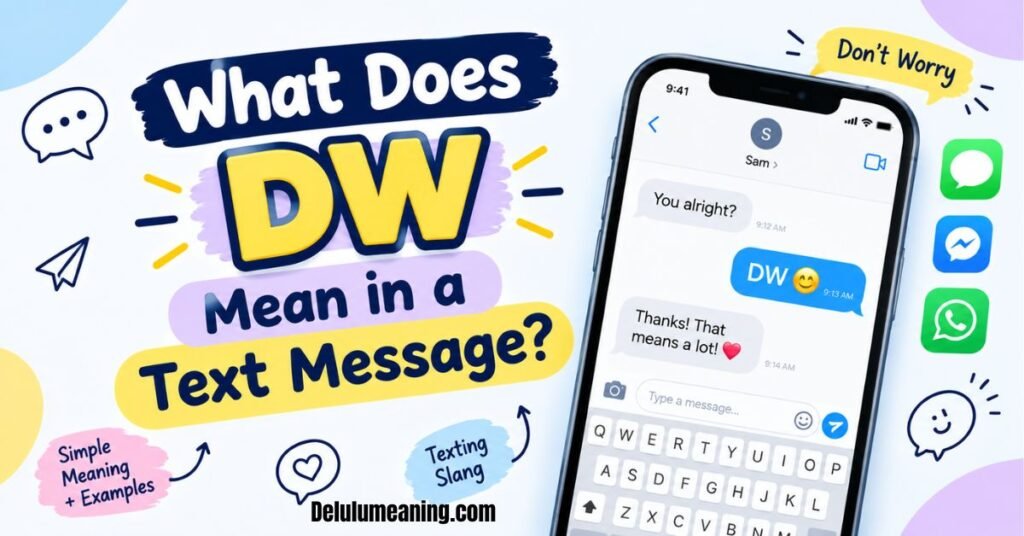
Picture this: “I’m running late, sorry!” followed by “DW, take your time.” That single reply removes any guilt or stress from the situation almost instantly.
Simple DW Meaning
Here’s the cleanest way to say it: DW = Don’t Worry, used to comfort, reassure, or dismiss a minor issue. That’s the whole DW definition, and it hasn’t changed much since texting culture began.
DW Meaning Examples
A few quick DW meaning examples show its range. “DW about the mess, I’ll clean it later.” “DW, everyone makes mistakes.” “DW, I’ll cover you this time.” Each one uses DW the same way lowering tension and offering comforting words fast.
Read More : What Does IRL Mean in Texting? Meaning, Examples & How to Use It
DW Meaning on Snapchat
DW Snapchat meaning deserves its own spotlight, since Snapchat culture leans heavily on quick, low-effort replies. On a platform built around speed and streaks, DW fits right in as a fast way to smooth things over.
Snapchat conversation habits favor short bursts over long paragraphs, and DW matches that rhythm perfectly. It shows up in captions, replies, and quick check-ins, almost always carrying the same reassuring tone.
What Does DW Mean on Snapchat?
On Snapchat, DW usually appears after a mistake or a missed Snap. “Missed your streak, DW though, we’ll start again” is a classic example of the phrase doing its job.
DW Meaning in Snapchat Chat
Within Snapchat messages, DW often responds to an apology. It signals that whatever happened isn’t a big deal, keeping the friendship or streak intact.
Why Do People Use DW on Snapchat?
Speed matters on Snapchat. DW lets users offer emotional reassurance without slowing down a fast-moving conversation, fitting naturally into the platform’s quick-tap culture.
DW Snapchat Examples
“DW, I’ll send a pic later.” “Lost my streak, DW, it’s just a number.” “DW about missing my story, I’ll post more later.” Each shows DW easing minor social friction.
Read More : What Does ASL Mean in Slang? ASL Meaning in Texting, Chat & Social Media
DW Meaning in Chat and Social Media
Social media slang has fully absorbed DW into its everyday vocabulary. Whether it’s an Instagram DM, a comment on TikTok, or a quick note in a WhatsApp chat, DW shows up constantly across online communication.
Each platform gives it a slightly different flavor, but the core idea stays fixed. It’s always about lowering worry, softening a moment, or offering quiet support without much fuss.
DW Meaning on Instagram
In Instagram replies, DW often follows an apology or a late response. “Sorry I missed your story!” “DW, no worries at all” is a common exchange.
DW Meaning on TikTok
TikTok comments use DW to reassure creators or other commenters. “DW, your video was still great even with the lag” shows support without overthinking it.
DW Meaning on WhatsApp
In a WhatsApp chat, especially group threads, DW often smooths over small mix-ups. “Forgot to reply earlier, DW, I saw it now” keeps things light.
DW Meaning in Facebook Messages
Within Facebook messages, DW plays a similar reassuring role, often used between older social media users catching up after a delay.
DW Meaning in Social Media Comments
Across comment sections generally, DW pops up as quick emotional support. “DW, everyone’s first post looks awkward” is the kind of comment that builds community goodwill.
Where Did DW Come From?
Every abbreviation has a starting point, and DW’s roots trace back further than most casual users realize. It didn’t begin as internet slang for viral trends it grew out of practical, everyday informal communication.
Understanding the origin of DW explains why it still feels natural today. It wasn’t built for a moment. It was built to solve a simple problem: reassuring someone quickly, without typing much.
Origin of DW
DW emerged from early texting culture, when character limits and slow typing speeds pushed people toward shorter phrases. “Don’t Worry” shrank naturally into two letters.
DW and Early Texting Culture
Back when SMS messages charged by character count, texting abbreviation habits like DW saved both time and money. Efficiency shaped the earliest slang, and DW was part of that wave.
The Influence of Internet Culture
As internet culture expanded through forums and instant messaging, DW spread beyond texting into broader online communication, becoming familiar across chatrooms and early social platforms.
How Social Media Popularized DW
Platforms like Snapchat, Instagram, and TikTok pushed DW into daily use for millions of social media users, cementing it as permanent social media communication vocabulary.
How the DW Meaning Has Evolved
Originally strictly reassuring, DW has picked up lighter, more casual uses over time. Today it can express genuine comfort or simply signal “it’s fine, moving on.”
DW Meaning in Real Texting Conversations
Seeing DW in context makes its meaning click instantly. Below are real-style examples showing how naturally it fits into everyday text conversation across different apps and situations.
These examples highlight something important: DW rarely stands alone. It almost always follows an apology, a worry, or a small mistake, stepping in to calm things down immediately.
DW in a Text Message Between Friends
“Sorry I forgot to text back!” “DW, I was busy too.” This kind of quick exchange happens constantly between close friends.
DW in a WhatsApp Conversation
“Running 10 minutes late.” “DW, take your time, no rush at all.” A simple, low-stakes example of DW meaning in messages.
DW in an Instagram DM
“Sorry for the late reply, been swamped.” “DW, I totally get it.” This kind of reply keeps the conversation warm despite the delay.
DW in a Snapchat Conversation
“Missed your Snap, sorry!” “DW, send one whenever.” Casual, quick, and typical of Snapchat conversation habits.
DW in a TikTok Comment
“My video quality looks so bad.” “DW, it’s still really good!” A supportive comment offering emotional support in a public space.
DW in Everyday Chat
“Ugh, I think I said something awkward earlier.” “DW, nobody even noticed.” This everyday reassurance is where DW shines most.
What Does DW Mean Emotionally?
Beyond the literal definition, DW carries real emotional weight. It’s rarely just information it’s a small act of kindness, offered quickly and often without much thought.
This emotional layer is exactly why DW has stuck around so long. Few two-letter phrases manage to calm someone down and make someone feel better this efficiently.
What Emotion Does DW Express?
DW usually expresses comfort, patience, and understanding. It tells the other person their concern has been heard and dismissed gently.
DW Meaning as Reassurance
As reassurance, DW works almost like a verbal pat on the back. It says, “This isn’t a big deal,” without needing extra explanation.
DW Meaning as Emotional Support
In moments of stress, DW offers quiet emotional support. A worried friend hears “DW, it’ll work out” and immediately feels a little lighter.
Why People Use DW
People reach for DW because it’s fast, warm, and low-effort. It reduces concern without requiring a long, thoughtful response every single time.
The Emotional Meaning Behind DW
At its core, DW shows compassion in miniature form. It’s proof that comfort doesn’t always need many words to land effectively.
DW Meaning in Different Contexts
DW doesn’t behave the same way in every setting. Between friends, it’s light and casual. In relationships or serious moments, it can carry deeper emotional stakes entirely.
Context shapes how DW lands. The same two letters can sound playful in a group chat or deeply comforting during a hard conversation, depending entirely on who’s saying it and why.
DW Meaning Between Friends
Among friends, DW usually stays light. “DW, I’ll grab it next time” barely registers as a big deal, just a casual moment of goodwill.
DW Meaning in Relationships
In relationships, DW often reassures a partner during a moment of doubt. “DW, I’m not upset with you” can genuinely ease tension.
DW Meaning in Dating
Early in dating, DW helps smooth over awkward moments. “DW about the weird text earlier, I get it” keeps things comfortable.
DW Meaning on Social Media
Publicly, DW often supports someone after a small embarrassment, like a typo or a low-quality photo, keeping the mood friendly.
DW Meaning at Work
In professional communication, DW usually appears only in casual internal chats. “DW, I’ll fix the typo in the doc” fits informal workplace messaging.
DW Meaning in Casual Conversations
In casual conversation, DW flows freely, attaching to almost any small mishap without much thought behind it.
DW Meaning in Serious Conversations
In more serious moments, DW slows down and means more. “DW, I’m here for you” carries genuine emotional depth.
DW Meaning in Different Tones
Tone changes everything about how DW reads. The same phrase can sound sweet, dismissive, or even sarcastic depending on the situation and the relationship between the people texting.
Recognizing tone takes a little practice, but context clues almost always give it away. Punctuation, emojis, and the conversation’s mood all shape how DW should be read.
DW as a Friendly Expression
Used casually, DW acts as a friendly expression, smoothing over tiny mishaps between people who trust each other.
DW as a Reassuring Expression
In more emotional moments, DW becomes a genuinely reassuring expression, offering real comfort rather than just brushing something off.
DW in a Casual Tone
Casually, DW barely carries weight. It’s closer to a shrug than a statement, used constantly without much emotional investment.
DW in a Serious Situation
In a serious moment, the same two letters can feel deeply supportive, especially paired with a longer, caring message right after.
Can DW Be Sarcastic?
Yes, in a sarcastic context, DW can flip meaning entirely. “Oh sure, DW about the huge mess you made” clearly isn’t reassuring at all.
When Should You Use DW?
Knowing when DW fits comes down to reading the room. It works beautifully in informal communication, but it can feel out of place in formal communication or high-stakes situations.
The safest approach: match DW’s casual energy to a casual setting. Save fuller phrases for moments that genuinely deserve more thought and detail.
When DW Is Appropriate
Texting friends, casual group chats, and light social media replies are all safe spaces for DW.
When to Use DW in Texting
Use it whenever a quick reassurance beats a longer explanation, especially over minor delays or small mistakes.
When to Use DW With Friends
Between close friends, DW works constantly, almost like a built-in shorthand for “it’s fine.”
When Not to Use DW
Avoid DW in serious emails, official documents, or moments requiring real empathy and full sentences instead of shorthand.
Should You Use DW in Professional Communication?
Only in casual internal chats. For anything client-facing or formal, write out “don’t worry” in full instead.
Common DW Meaning Misunderstandings
A few mix-ups happen often enough to clear up directly. Most confusion comes from tone, not the actual definition, which stays fairly consistent across contexts.
Understanding these misunderstandings helps readers use DW more confidently, without accidentally sounding dismissive when they mean to be kind, or vice versa.
Does DW Mean Something Negative?
No. DW is almost always positive or neutral, meant to offer comfort rather than criticism.
Is DW Ever Sarcastic?
Yes, occasionally. Tone and context determine whether DW is genuine or sarcastic, so surrounding words matter.
Can DW Have Different Meanings?
Not really different meanings, just different intensities, ranging from a casual shrug to genuine emotional support.
DW Literal Meaning vs Emotional Meaning
Literally, DW means Don’t Worry. Emotionally, it can mean anything from “it’s fine” to “I truly care about how you feel.”
Why Context Matters When Understanding DW
Context determines everything. The same message from a close friend versus a stranger can land completely differently.
DW Meaning Variations and Common Expressions
DW attaches easily to other words, forming a small family of related phrases. Here’s a quick breakdown of common DW variations people use daily.
| Variation | Meaning |
| DW | Standard “Don’t Worry” |
| DWW | Emphasized “Don’t Worry” (rare, informal) |
| DW 🙂 | Softened, friendly reassurance |
| DW Bro | Casual, common among male friends |
| DW Mate | Casual, common in British/Australian texting |
| DW About It | Full dismissive reassurance |
| DW I’ll Handle It | Reassurance plus ownership |
| DW We Got This | Team-based reassurance |
| DW Everything’s Fine | Extended comfort |
| DW You’re Good | Casual dismissal of a small mistake |
DW Meaning vs Similar Texting Expressions
DW belongs to a wider group of reassurance phrases. Here’s how it compares to other common expressions people use interchangeably.
| Expression | Meaning | Tone Difference |
| DW vs No Worries | Nearly identical meaning | “No worries” sounds slightly warmer |
| DW vs It’s Okay | Both reassure | “It’s okay” feels more personal |
| DW vs Relax | Both calm someone down | “Relax” can sound more direct or blunt |
| DW vs Chill | Similar casual tone | “Chill” leans more playful |
| DW vs NVM | Different meaning | NVM means “drop the topic,” not reassurance |
| DW vs IDC | Different meaning | IDC means indifference, not comfort |
How to Respond When Someone Says DW
Knowing how to respond to DW keeps conversations flowing naturally. The right DW response depends on tone, matching the same energy the original message carried.
A thoughtful reply usually mirrors the warmth of DW itself. Since it’s meant to comfort, most replies work best when they’re short, kind, and low-pressure.
Casual Replies to DW
“Okay, thanks!” or “Appreciate it” both work well in relaxed exchanges.
Funny Replies to DW
“DW? Now I’m definitely worried” adds light humor while still acknowledging the reassurance.
Friendly Replies to DW
“That means a lot, thank you” shows genuine appreciation for the gesture.
Mature Replies to DW
“I appreciate you saying that, it really helps” fits deeper, more meaningful conversations.
Respectful Replies to DW
“Thanks for understanding” shows patience and respect right back.
How to Reply to “DW” in Texting
Match the tone you received. Casual DW gets a casual reply; heartfelt DW deserves a slightly warmer one in return.
DW Meaning Across Different Generations
Generational differences shape how often DW gets used, even though the meaning itself barely changes across age groups.
Younger users tend to use DW constantly and casually, while older generations lean toward the full phrase, reserving shorthand for closer relationships only.
DW Meaning for Gen Z
Gen Z slang treats DW as everyday vocabulary, used constantly across texting and social platforms without much thought.
DW Meaning for Millennials
Millennial slang helped popularize DW early on, especially through instant messaging and early social media platforms.
DW Meaning for Older Generations
Older users often understand DW but use it less frequently, generally preferring the full phrase in most conversations.
Is DW Still Used Today?
Yes, absolutely. DW remains common across global internet usage, staying relevant well beyond its early texting origins.
DW Meaning in Different Cultures
DW’s meaning stays consistent worldwide, but usage frequency shifts depending on region and online culture.
Global internet usage has helped spread DW far beyond its original English-speaking roots, especially among younger, internet-fluent populations everywhere.
DW in Western Internet Culture
In the U.S., U.K., and Australia, DW is extremely common across texting, gaming, and casual chat.
DW in Asian Social Media
Across parts of Asia, DW appears frequently among bilingual and English-fluent younger users, especially on international apps.
DW Among Bilingual Internet Users
Many bilingual users mix DW naturally into conversations in other languages, treating it as a universal shorthand for comfort.
DW in Global Online Communication
As modern communication becomes increasingly international, DW has become one of many shared abbreviations understood across borders.
Is DW Safe for Kids?
Yes, DW is completely harmless. It carries no inappropriate meaning and shows up constantly in everyday conversations among younger social media users.
As always, the surrounding context matters more than the phrase itself, especially in conversations involving unfamiliar people online.
What Does DW Mean for Kids?
For kids, DW usually just means comfort after a small mistake, like a missed message or a minor mix-up with friends.
Is DW a Safe Texting Abbreviation?
Yes, it’s considered completely safe and appropriate for all ages across texting and chat platforms.
Why Context Matters in Online Conversations
Parents should still pay attention to who kids are chatting with, since safety depends on the relationship, not the abbreviation itself.
FAQs About DW Meaning
What Does DW Mean in Texting?
DW means Don’t Worry, used to reassure or comfort someone quickly.
What Does DW Mean on Snapchat?
The same meaning applies it’s used to ease small mistakes like missed Snaps or broken streaks.
What Does DW Stand For?
DW stands for Don’t Worry.
What Is the DW Meaning in Chat?
In chat apps generally, DW offers quick reassurance without needing a full explanation.
Is DW a Slang Word?
Yes, it’s a widely recognized piece of internet slang.
Is DW a Positive Expression?
Yes, in almost all cases, DW carries a positive, comforting tone.
Is DW Rude?
No, though in a sarcastic context, it can occasionally sound dismissive.
Can DW Have Different Meanings?
The core meaning stays the same, though intensity and tone can shift by context.
Is DW the Same as No Worries?
Nearly identical, with “no worries” sounding slightly warmer in most cases.
Is DW Still Used by Gen Z?
Yes, it remains extremely common in Gen Z slang today.
Can I Use DW in Professional Communication?
Only casually, in informal internal chats, not formal emails or documents.
How Do You Respond to DW?
A short, warm reply like “thanks” or “I appreciate that” usually fits best.
Conclusion: DW Meaning Explained
At its heart, DW simply means Don’t Worry two letters carrying real warmth. It softens conversations, eases small mistakes, and offers a quick dose of emotional reassurance whenever someone needs it.
Next time a message ends with “DW,” you’ll know exactly what’s happening. It’s not just texting slang. It’s a tiny, everyday act of kindness, proving that comfort doesn’t always need many words to make someone feel better.

Ethan Parker is a language and culture writer who enjoys exploring modern slang, internet expressions, and everyday word meanings. Through DeluluMeaning.com, he breaks down confusing and trending terms into clear, simple explanations that are easy for everyone to understand.


2 Comments